


Academic Frontiers: A Systematic Review and Meta-Analysis Comparing CHIVA with Conventional Stripping and Ablation
I. Publication Information
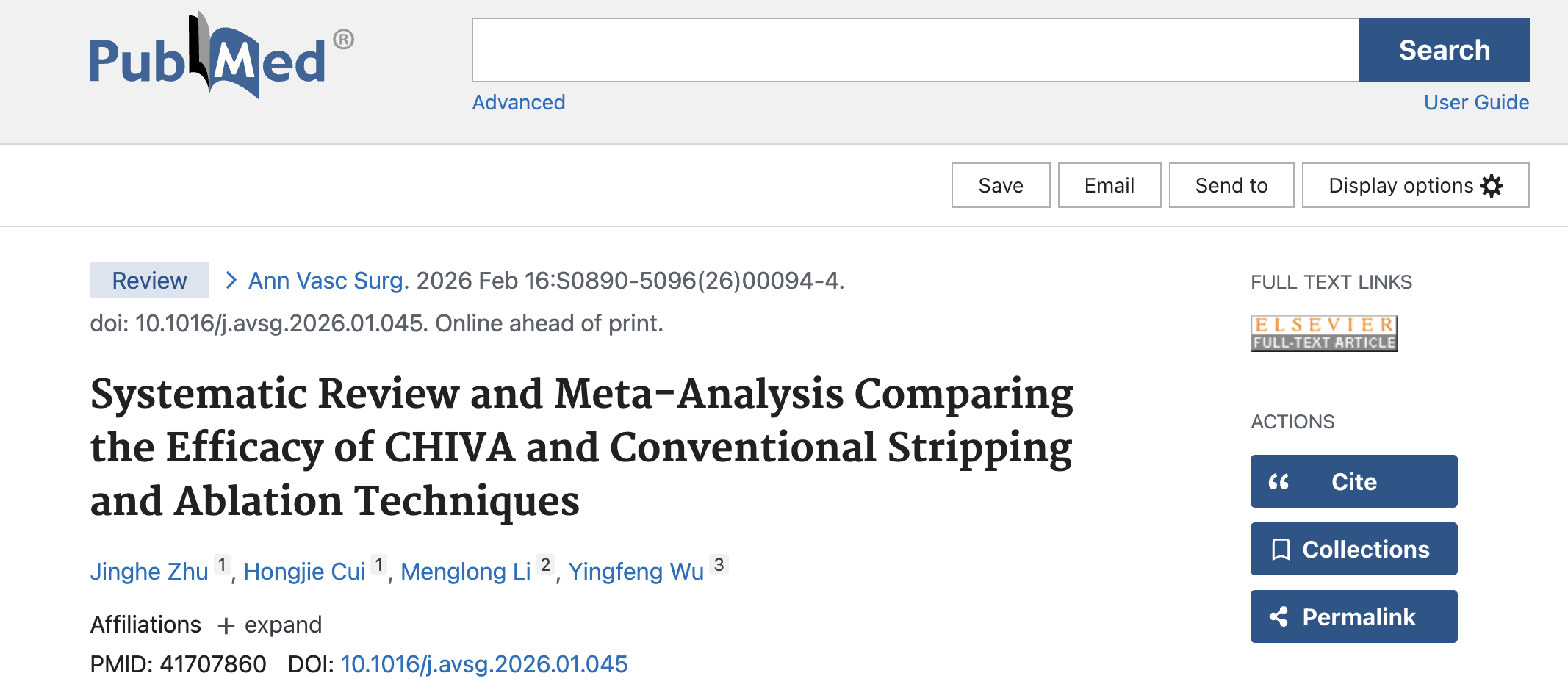
- Journal: Annals of Vascular Surgery
- Title: Systematic Review and Meta-Analysis Comparing the Efficacy of CHIVA and Conventional Stripping and Ablation Techniques
- Authors: Jinghe Zhu, Hongjie Cui, Menglong Li, Yingfeng Wu
- Publication Date: February 16, 2026
II. Background and Study Scale
This systematic review synthesized evidence from 11 studies (comprising 3 randomized controlled trials and 8 cohort studies), encompassing a total sample size of 13,089 patients. The objective was to evaluate the efficacy of the hemodynamic-based CHIVA method relative to traditional destructive surgical techniques.
Distribution of Patient Cohorts:
- CHIVA Group: 6,908 cases
- Conventional Stripping Group: 5,988 cases
- Endovenous Laser Ablation (EVLA) Group: 110 cases
- Radiofrequency Ablation (RFA) Group: 83 cases
III. Core Research Findings
1. Superior Outcomes (Favoring CHIVA)
- Saphenous Nerve Injury:The risk of nerve injury was significantly lower in the CHIVA group compared to the stripping group ($RR: 0.07; 95\% \text{ CI}: 0.02, 0.22; P < 0.0001$). CHIVA also demonstrated a superior safety profile compared to thermal ablation techniques (EVLA/RFA) ($RR: 0.14; 95\% \text{ CI}: 0.03, 0.74; P = 0.02$).
- Postoperative Ecchymosis:CHIVA significantly reduced the incidence of postoperative bruising compared to alternative treatments ($RR: 0.62; 95\% \text{ CI}: 0.54, 0.71; P < 0.0001$).
2. Clinical Equivalence
No statistically significant differences were observed between CHIVA and the control groups (stripping or ablation) regarding the following parameters:
- Recurrence rates
- Thrombophlebitis
- Wound infections
IV. Conclusion and Recommendations
The study concludes that the CHIVA technique offers distinct advantages in minimizing postoperative saphenous nerve injury and ecchymosis. Furthermore, it maintains equivalence to conventional destructive methods in terms of long-term recurrence and infection risks, supporting its role as a viable, conservative hemodynamic alternative.
We welcome inquiries regarding academic collaboration, joint scientific meetings, educational initiatives, and appropriate institutional support aligned with the Academy’s mission.