


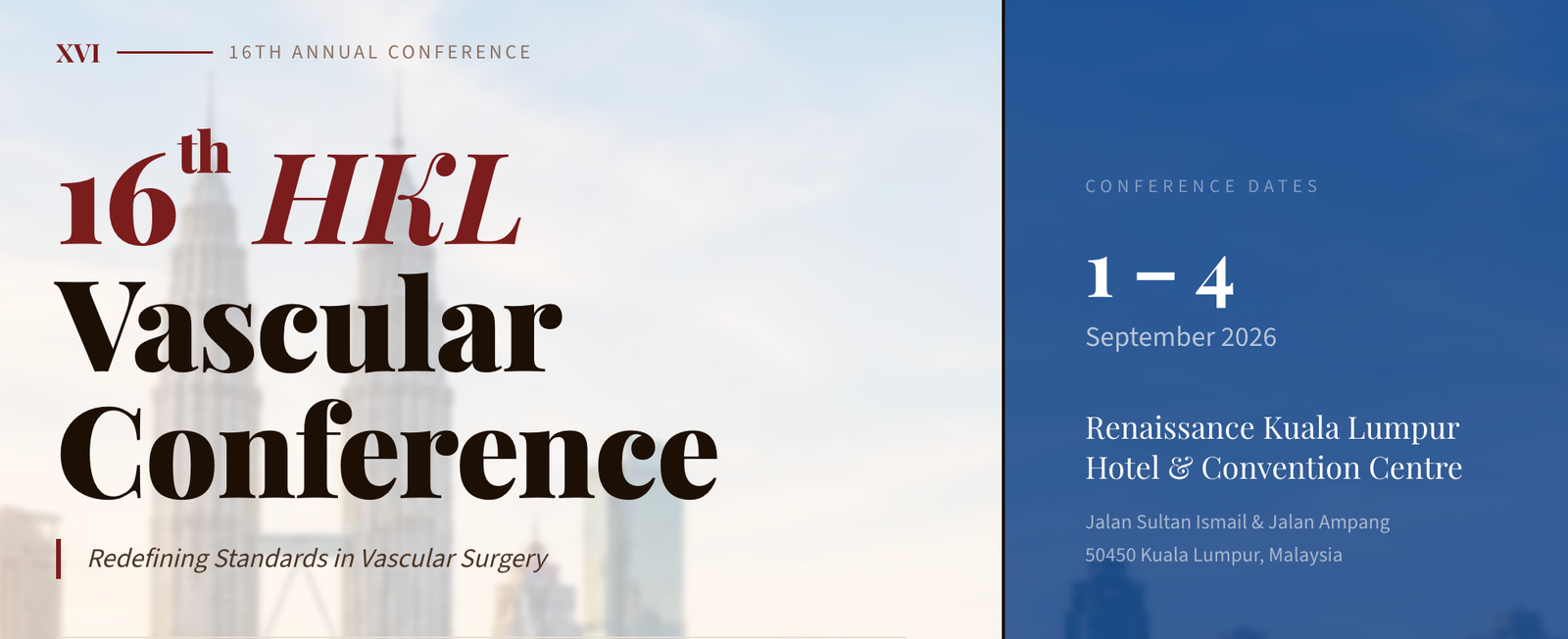
KUALA LUMPUR — The 16th HKL Vascular Conference will take place from 1–4 September 2026 in Kuala Lumpur, bringing together vascular surgeons, interventional specialists and allied healthcare professionals for four days of scientific exchange, clinical debate and hands-on training.
Organised by the Vascular Unit, Department of General Surgery at Hospital Kuala Lumpur, the annual meeting will be held under the theme “Redefining Standards in Vascular Surgery.”
The main congress, scheduled for 2–3 September at the Renaissance Kuala Lumpur Hotel & Convention Centre, will be preceded by a series of practical workshops on 1 September and followed by a post-congress masterclass at Hospital Kuala Lumpur on 4 September.
The programme reflects a broader shift within modern vascular surgery, where rapid advances in endovascular technology continue to reshape treatment strategies while open surgical expertise remains essential in selected complex disease settings.
From Guidelines to Real-World Decision-Making
A central feature of this year’s scientific programme is its emphasis on translating evidence and guidelines into practical clinical decision-making.
Peripheral arterial disease will be among the major areas of discussion, with sessions examining the evolving balance between endovascular-first and bypass-first strategies.
Topics include the role of drug-based devices in peripheral arterial disease, complex lower-limb endovascular intervention, and newer approaches to aortoiliac reconstruction.
Rather than focusing solely on emerging technologies, the programme places these developments within the context of patient selection, durability, procedural complexity and real-world outcomes — questions that remain central to contemporary vascular practice.
Aortic Disease in the Endovascular Era
The management of aortic pathology represents another important focus of the meeting.
Dedicated sessions will address blunt traumatic aortic injury, acute aortic syndromes including intramural haematoma and penetrating aortic ulcer, and contemporary approaches to aortic arch repair.
The programme will also revisit a fundamental question facing vascular specialists worldwide: where does open surgery continue to offer an advantage in an increasingly endovascular era?
The discussion is particularly relevant as new devices and minimally invasive techniques continue to expand the range of aortic disease that can be treated endovascularly. At the same time, anatomy, patient age, long-term durability and procedural risk continue to require highly individualised treatment decisions.
Complex Cases, Different Strategies
One of the conference’s notable sessions, “Challenging Cases — Different Minds, Different Strategies,” will place clinical reasoning at the centre of the discussion.
Cases and presentations will cover areas including pulmonary embolism, thoracoabdominal aortic aneurysm, chronic limb-threatening ischaemia and newer vascular interventions.
The format recognises an important reality of vascular surgery: complex disease does not always have a single technically correct solution.
Different surgeons may approach the same pathology with different strategies depending on anatomy, available technology, institutional experience and the individual patient’s overall condition.
By presenting these differences openly, case-based discussions can provide insight not only into what experts do, but also into why they choose one strategy over another.
Preserving Surgical Skills Alongside Technological Innovation
Although vascular surgery has become increasingly technology-driven, the HKL programme also maintains a strong focus on fundamental operative skills.
Pre-congress training on 1 September includes a Basic Anastomosis Workshop, an In-Situ Bypass Workshop, and a comprehensive Wound Care Workshop.
The vascular anastomosis programme combines theoretical instruction with practical training in arteriotomy, patch repair, and end-to-side and side-to-side anastomoses.
The in-situ bypass programme similarly integrates lectures, demonstrations and hands-on training.
Meanwhile, the wound care workshop takes a multidisciplinary approach, covering wound assessment, compression therapy, negative-pressure wound therapy, non-invasive vascular assessment, ultrasonic-assisted wound debridement and amputee rehabilitation.
The inclusion of these sessions underscores the continuing importance of technical fundamentals even as endovascular practice expands.
Extending Education Beyond the Main Congress
Following the two-day scientific congress, a post-congress masterclass will be held at the Specialist and Ambulatory Care Complex at Hospital Kuala Lumpur on 4 September.
Together, the workshops, main scientific sessions and masterclass create a four-day educational structure spanning basic surgical technique, advanced vascular intervention and complex clinical decision-making.
This combination of procedural training and scientific discussion reflects the increasingly multidisciplinary nature of modern vascular care.
A Regional Platform for Vascular Exchange
Now in its 16th edition, the HKL Vascular Conference has developed into an established platform for vascular education and professional exchange in Malaysia and the wider Southeast Asian region.
Its relevance extends beyond the introduction of new devices or techniques.
Across vascular surgery, clinicians are increasingly being asked to determine not simply what treatment is technically possible, but what approach offers the most appropriate balance of safety, durability and long-term benefit for an individual patient.
Questions surrounding open versus endovascular repair, revascularisation strategy, limb preservation, complex aortic intervention and multidisciplinary vascular care therefore remain at the centre of contemporary practice.
Against this background, the theme of the 2026 meeting — “Redefining Standards in Vascular Surgery” — captures a broader transition taking place across the specialty.
As technology expands the boundaries of intervention, defining the next standard of vascular care will depend not only on innovation, but also on evidence, surgical judgement, technical expertise and the ability to select the right treatment for the right patient.
Conference at a Glance
Event: 16th HKL Vascular Conference 2026
Theme: Redefining Standards in Vascular Surgery
Dates: 1–4 September 2026
Pre-Congress Workshops: 1 September
Main Congress: 2–3 September
Post-Congress Masterclass: 4 September
Main Venue: Renaissance Kuala Lumpur Hotel & Convention Centre, Kuala Lumpur, Malaysia
Organiser: Vascular Unit, Department of General Surgery, Hospital Kuala Lumpur
Official Conference Website:
https://hklvascular.com/
Programme details are subject to change. Readers are advised to refer to the official conference website for the latest information.
We welcome inquiries regarding academic collaboration, joint scientific meetings, educational initiatives, and appropriate institutional support aligned with the Academy’s mission.
Progress in medicine is sustained by independence of thought and generosity of knowledge.
